Your company should improve itself. SupraOS makes that executable.
SupraOS learns how your company runs, detects value leaks and execution risks, launches governed work through approved Charters, coordinates humans and agents, and proves every action and business outcome through Receipts and the Value Ledger.
Trust line: Read-only first. Mandates, not prompts. Policy before action. Receipts by default.
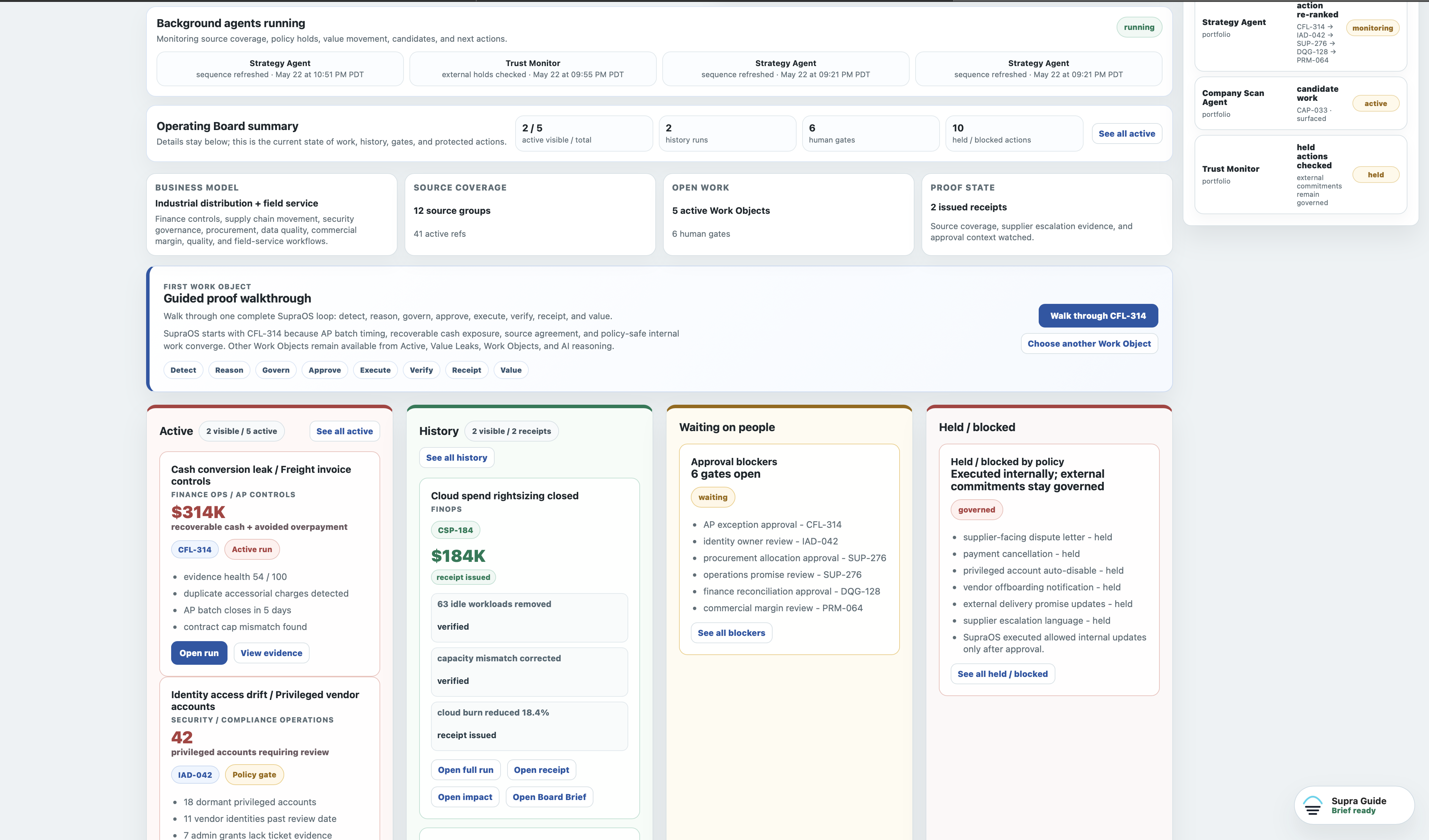
Read-only scans surfaced the leaks. Governed runs proved the recovery loop.
Across evaluated scan work and pilot work, SupraOS has surfaced value exposure, converted signals into governed Work Objects, routed approval gates, verified permitted writebacks, and separated active risk from confirmed value.
Detected
Value leaks are ranked by exposure, evidence strength, policy state, and next action.
Governed
Allowed, held, and blocked actions are classified before execution.
Proven
Receipts and the Value Ledger separate active risk, confirmed value, and unresolved exposure.
Confirmed value, active risk, surfaced exposure, and validated findings are tracked separately. SupraOS only counts value as confirmed when operators validate it, systems verify it, or receipts support the outcome.
The same execution gaps repeat across very different workflows.
Across 20 evaluated cases, SupraOS repeatedly found value and proof gaps hiding between systems, owners, approvals, evidence, and context.
Revenue Recovery
Incident Evidence Closure
Spend + Procurement Leakage
Approval Recovery
Vendor + SLA Follow-through
Operating Review
What repeated: read-only source exports were enough to surface missing owners, stale approvals, evidence gaps, duplicated work, value leakage, and Charter candidates before any broad execution rights were granted.
Dashboards show. Workflow tools track. Agents wait. SupraOS runs.
Dashboards
Show what happened and wait for humans to interpret what to do next.
Workflow tools
Track work someone already entered, but miss work nobody has assigned.
Agents
Do what they are told. They need a prompt, task, or workflow.
SupraOS
Finds what needs doing, launches the work under mandate, coordinates humans and agents, and proves the outcome.
No invisible human glue holding the stack together.
Your teams already operate across records, tickets, docs, chats, meetings, metrics, contracts, dashboards, internal tools, and agents. The problem is not that tools do not exist. The problem is that no neutral system owns the work between them.
SupraOS sits above the approved stack, understands how work moves, creates missing Work Objects, orchestrates humans and agents, runs approved actions, and proves every step with Receipts.
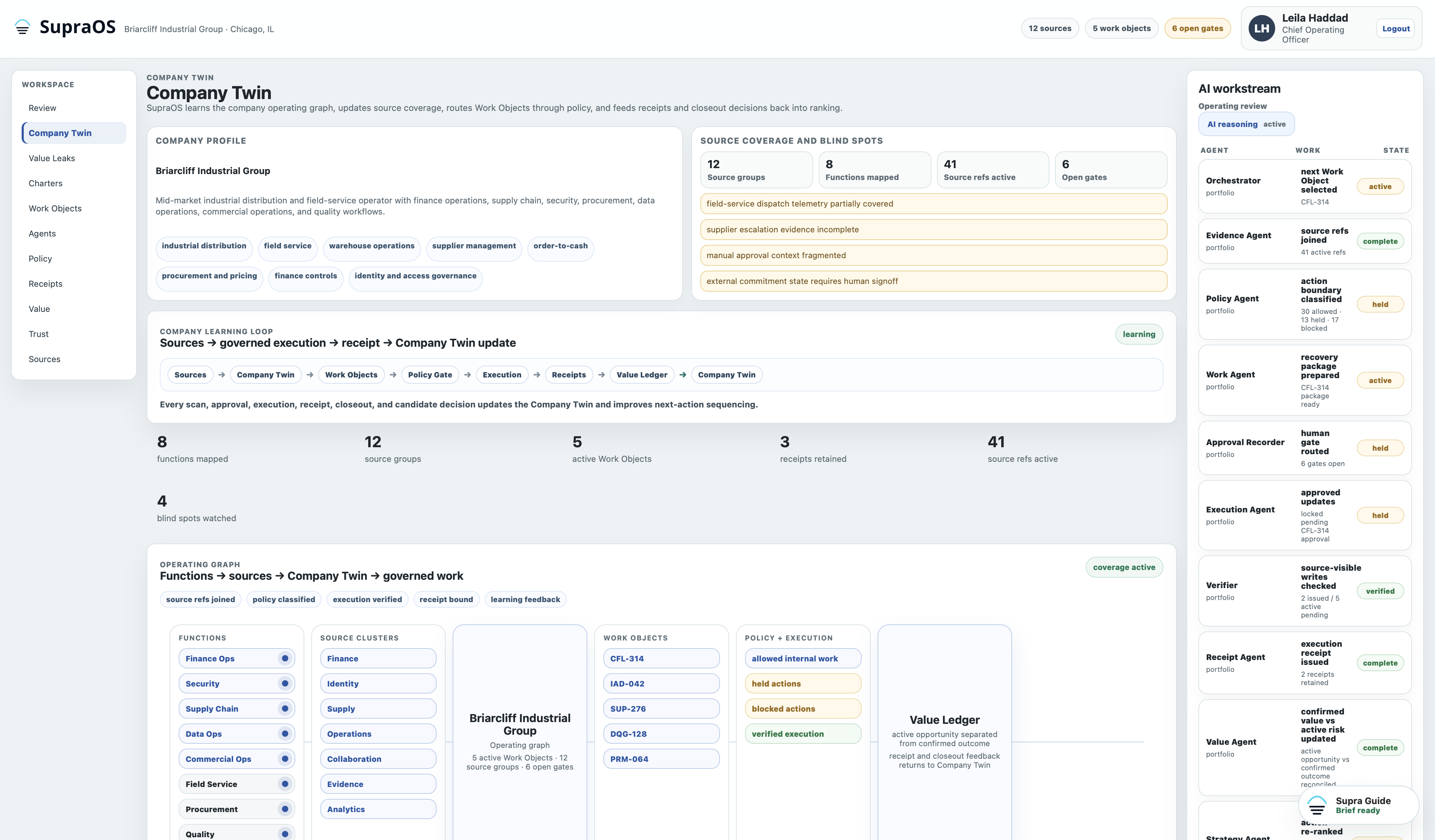
Start with one Charter. Prove one outcome. Expand from there.
SupraOS is broad by design, but the first deployment should be narrow: one Company Scan, one Charter, one measurable outcome.
Revenue Recovery
Recover leaked revenue before it becomes churn, leakage, or expansion drag.
Start with Revenue Recovery →Incident Evidence Closure
Close missing follow-up and proof gaps after high-stakes incidents.
Start with Evidence Closure →One Charter run, from signal to Board Brief.
A Charter turns one operating leak into governed execution: evidence, risk, recovery package, approval, execution, receipt, value state, and Board Brief.
The operating review generated before anyone asks.
SupraOS converts source coverage, active Work Objects, policy gates, Company Twin learning, execution state, and Value Ledger movement into a decision-grade operating artifact.
Receipts prove every action. The Value Ledger proves why it mattered.
A log says something happened. A SupraOS Receipt proves why it happened, who or what acted, what policy applied, what approvals were required, which systems were touched, what evidence supports the action, and what outcome was produced.
Receipt
Intent, policy, approval, actor, system touched, evidence, and verifier state.
Value Ledger
Detected exposure, active risk, confirmed value, unresolved exposure, and next monitor.
Autonomous does not mean uncontrolled.
SupraOS can self-start because its authority is not stored in prompts. It is stored in Charters, source scopes, permissions, policies, approval rules, autonomy modes, evidence requirements, and Receipts.
Read-only discovery first
SupraOS maps before it acts.
Policy before action
Every governed action checks authority.
Receipts by default
Proof binds evidence, policy, action, and outcome.
Source coverage and blind spots
SupraOS shows what it can and cannot see.
Human approval for high-risk work
External, financial, legal, production, and access changes require gates.
Controlled disclosure
Prove integrity without exposing sensitive content unnecessarily.
Built from the enterprise execution gap.
SupraOS comes from repeated exposure to the same failure pattern: enterprises do not lack tools. They lack a neutral operating layer that knows what matters, creates the missing work, orchestrates the stack, runs approved work, and proves outcomes.
Founded by Hassan Al‑Shama, SupraOS productizes the repeatable operating work of elite consultants and operators into an always-on execution runtime.
Trusted, selected, or incubated through global innovation ecosystems.

Start with a Company Scan. Then run one Charter.
SupraOS starts read-only. It maps approved signals, identifies value leaks, recommends the first Charter, defines authority boundaries, runs Work Objects inside those boundaries, and returns Receipts plus a Value Ledger review.
Company Scan
Source coverage, Company Twin preview, blind spots.
First Charter
Select one mandate and proof model.
Run Work Objects
Agents execute approved tasks.
Value Review
Receipts and Value Ledger review.
Request a Company Scan
Tell us where the operating pain lives.